Showing posts with label 1941. Show all posts

Thursday, December 9, 2010

The Gang's All Here (1941)

The gang may be here, but it's nothing to get excited about, 27 October 2008

A series of truck hijackings threatens to put the Overland Transport Company out of business. In fact, the company is so desperate, they agree to hire the inexperienced team of Frankie O'Malley (Frankie Darro) and Jeff Smith (Mantan Moreland) to be their saving grace. But who's really behind the hijackings? When Frankie and Jeff find themselves on the wrong end of a gun barrel, it soon becomes apparent just who the bad guys really are.

It's a good thing that The Gang's All Here only runs 61 minutes. Anymore and it would have overstayed its welcome. Oh, it's okay I suppose in an inoffensive sort of way, but it's an awfully lifeless way to spend an hour. While some of the movie is mildly entertaining, most scenes are just plain old dull. The only real entertainment comes from Mantan Moreland. He's one of those few people with enough talent and screen presence to make anything worth watching at least once. This is the first movie I've seen where Moreland is paired with Frankie Darro. I've noticed that the two made a few more movies together, but I'm not sure how much of a hurry I'm in to seek them out. Darro did absolutely nothing for me. In fact, I more often than not found his on-screen persona annoying. The rest of the cast is unremarkable and completely unmemorable. The plot – boring is the first word that comes to mind. And the supposed action sequences are anything but. Maybe there are better Darro/Moreland movies out there, but it will be a while until I'm up for discovering them.

4/10

Friday, November 26, 2010

The Gay Falcon (1941)

Very entertaining beginning to the Falcon series, 13 March 2008

The Gay Falcon, the first movie in the Falcon series, finds the Falcon (George Sanders) ready to give up both women and detective work at the request of his fiancé. This promise, however, doesn't last long as a pretty woman with a story of stolen jewelry soon walks into his life. In no time at all, the Falcon is up to his elbows in murder and hiding out from the police. The only way to clear his name is to find the real killer.

This may have been George Sanders first time out in the role of the Falcon, but he wears the role with the familiarity of a favorite old sweater. I would argue, however, that his Saint series (which ended just prior to the start of the Falcon series) was so similar to the Falcon that it was hardly a stretch for Sanders. Regardless, Sanders makes everything seem so effortless and natural. He is joined by an especially strong cast. Gladys Jenkins, Edward Brophy, and Arthur Shields should be familiar to any fan of classic B-fare. Oddly though, all are upstaged by the strong performance of Nina Vale who surprisingly only appeared in two other films. I can't believe she didn't do more. She's quite good and imminently watchable. As for the movie, none of the Falcon movies are particularly deep affairs and The Gay Falcon is no different. It's light, breezy entertainment. The 1940s style of comedy/mystery films has always appealed to me and The Gay Falcon is a nice example. The comedy elements hit their mark and are, at their worst, amusing. Nothing to make you fall in the floor with laughter, just good, light-hearted fun. The mystery elements in the movie also work and are sufficiently convoluted to make it interesting throughout. And it helps that the final solution to the mystery at least makes sense and is ultimately satisfying. Director Irving Reis keeps things moving at an entertaining pace with no time for a wasted scene in the movie's relative short 67 minute runtime. Overall, it's a solid effort.

7/10

Sunday, August 22, 2010

Man Made Monster (1941)

"Terrible? Is it terrible that I gave him life?", 6 October 2007

After surviving an accidental electrocution, Dan McCormick (Lon Chaney, Jr.) comes to the attention of a couple of scientists doing work with the effects of electricity on the human body. While Dr. Lawrence's intentions are very noble and above reproach, Dr. Rigas (Lionel Atwill) has other, more "sinister" applications in mind for their experiments. His idea is create, through repeated exposure to extreme levels of electricity, an army of supermen to do his bidding. And Dan McCormick represents the ideal test subject.

Man Made Monster might be considered a "lesser" Universal horror film, but it's a good one. I haven't seen it in literally decades and I'm happy to report that it held up rather well. It's not as good as some of Universal's better known films, but it's a solid, entertaining effort. Director George Waggner (who would go on to direct Chaney in The Wolf Man) does a marvelous job of keeping things moving at a nice pace. None of the relatively short 59 minutes is wasted. Chaney, always good at playing the sympathetic figure, does so here as well as ever. Atwill has always been underrated in my eyes and he gives one of his most demented performances as Dr. Rigas in Man Made Monster. The special effects are "cool" for the lack of a better word. The glowing Chaney works. Overall, this is one that deserves a much wider audience, especially among horror fans. Even though it's a limited release, hopefully the new R1 DVD release will put Man Made Monster into the hands of more fans.

7/10

The Black Cat (1941)

"He must think he's Sherlock Holmes", 4 October 2007

The family of Henrietta Winslow gathers in her old rambling house for the reading of her will. Problem is, Henrietta's not dead. But this greedy bunch will soon see to that. Before you can say "Watch out Granny!", she's been murdered. And Henrietta won't be the only person murdered this night as greed takes hold of everyone involved.

Based on what I've read over the years about the 1941 version of The Black Cat, I'm a little surprised at how much I enjoyed it now that I finally had the opportunity to see it. No, it's not the best thing that Universal put out, but it is an enjoyable little mystery/thriller with a great setting and a strong cast. On its face, The Black Cat would seem to be a movie tailor-made for me – a creepy dark old house filled with hidden rooms and secret passages, a dark and stormy night, Basil Rathbone, multiple murders with multiple suspects, Bela Lugosi, and no escape because of a washed-out bridge. What's not to love about the set-up? The Black Cat successfully mixes comedy with the chills – something that can be difficult to successfully do. There's a scene with Lugosi doing his best impersonation of a cat-wrangler that had me laughing out loud. Or the scene where one character condescendingly remarks that Rathbone's character must think he's Sherlock Holmes – good stuff! I found the ending to be very satisfying. After a delightful series of red herrings, it's always a treat to discover the killer is the absolute last person you would have considered. And while I mentioned Rathbone and Lugosi, the entire cast is great. Even Broderick Crawford, seemingly terribly miscast as the films unlikely hero, is a lot fun.

Overall, I'm very happy to have finally "discovered" The Black Cat. It's one I'm already looking forward to revisiting.

7/10

Monday, August 9, 2010

The Devil Commands (1941)

A misleading title, 8 July 2006

In The Devil Commands, Boris Karloff is Dr. Julian Blair, a scientist working on experiments with brain waves. When his wife suddenly dies, he is so distraught that he turns his attention to using his brain wave machine to contact his wife. He meets a medium named Mrs. Walters (Anne Revere) who may hold the key to his success. But Mrs. Walters has another idea for Dr. Blair's experiments. She sees the opportunity to make a fortune with Dr. Blair's machine if he's successful. And she will stop at nothing to see that the experiments succeed.

To begin with, I have no idea what the title, The Devil Commands, has to do with anything in the movie. It's Mrs. Walters who is directing the events in the movie, not the devil. But I suppose a title like Mrs. Walters Commands wouldn't have been nearly as intriguing or saleable.

Although Karloff is the star of this movie, he has surprisingly little to do. He plays a one note character with an overwhelming desire to contact his dead wife. Karloff gives a decent performance, but he's just not very interesting. It's Anne Revere that makes The Devil Commands worth watching. She gives an understated, but delightfully evil performance and dominates everything on screen. The rest of the cast is okay, but no one stands out.

The highlight of the movie has to be the final scenes in Dr. Blair's laboratory. The sight of several dead bodies sitting around a table connected to the brain wave machine is morbidly fascinating. Unfortunately, too much of the movie is only average and no where near as fun as the final moments.

6/10

Sunday, August 8, 2010

Suspicion (1941)

"Oh, I beg your pardon. Was that your leg?", 16 June 2006

Suspicion could have been one of Alfred Hitchcock's best films. Up to the final few minutes of the film, it's wonderful. I even enjoyed (or at least didn't mind) the long-winded verbal exchanges that some viewers seem to dislike. I'm a fan of intelligent, well-written dialogue and that's what I found for most of Suspicion's runtime. Hitchcock masterfully uses these scenes to build doubt in the viewers mind. Cary Grant is perfectly cast as the playboy husband with more than a few secrets to hide. Could there really be a killer hiding behind that handsome, jovial, carefree exterior? As for Joan Fontaine, I know I'm starting to sound like a broken record by praising performance after performance, but she is amazing. She plays the bookish, timid old-maid so believably. Her character is one who is easy to sympathize with and fret over as you begin to fear for her life. It's very nicely done.

It's a shame that Hitchcock was saddled with this ending. It feels rushed, tacked-on, and sloppy. It successfully puts a damper on everything that comes before it. It's something of a cruel joke. I was reminded of the famous shower scene from the television show Dallas when we as viewers are told to forget about everything we had seen. It didn't happen. Doing a little reading since I finished watching Suspicion, I've read the description of the ending Hitchcock originally intended to shoot and use. And I'm in agreement with most everyone else – the original ending would have been great. It's too bad the studio and Grant's people felt the need to have it changed.

7/10

Tuesday, August 3, 2010

The Shanghai Gesture (1941)

A tragic story with quite the entertaining group of characters, 30 April 2006
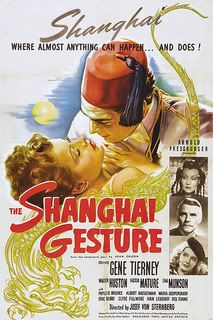

'Mother' Gin Sling (Ona Munson) runs a very successful gambling house in Shanghai. Through her doors pass a wide variety of individuals from every exotic corner of the globe. One such individual is a spoiled young woman who goes by the name of "Smith" (Gene Tierney) with a penchant for gambling and drink. It's not long before "Smith" is up to her eyeballs in IOUs and well on her way to becoming a complete lush. Coinciding with these events, a wealthy man named Sir Charteris (Walter Huston) arrives in Shanghai. Part of his business deal involves the land that 'Mother' Gin Sling's establishment sits on. 'Mother' Gin Sling believes she may have previously met Sir Charteris, but under a different name and in far different circumstances. To save her business, 'Mother' Gin Sling puts two and two together to connect "Smith" with Sir Charteris and lets the chips fall where they may.

Many of the people who care about and enjoy older films like The Shanghai Gesture will no doubt pick-up the film because of Gene Tierney – the biggest "star" in the cast. But they'll quickly discover that The Shanghai Gesture is so much more than Tierney. The movie features a wonderful ensemble cast playing a group of highly eccentric characters. To begin with, there's Ona Munson as 'Mother' Gin Sling. Maybe it's the costuming and maybe it's the attitude, but I bought her performance. Next, there's Victor Mature as Dr. Omar the Arab gigolo. He's the kind of fellow best described as slimy. Two of my favorite characters in The Shanghai Gesture are Eric Blore as Ceasar the English bookkeeper to 'Mother' Gin Sling and Clyde Filmore as 'Mother' Gin Sling's flunky, Percival Montgomery Howe. Mix in an American showgirl, a Russian barkeeper, a rickshaw driver of questionable origin, and about a half-dozen others and you've got quite an eclectic and entertaining group of actors and characters.
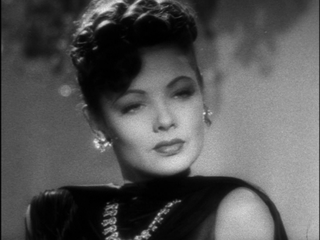
As much fun as the people in the film are, at its core, The Shanghai Gesture is a terribly tragic and sad story. Most of the people who come to 'Mother' Gin Sling's place do so because they have to, not because they want to. Whether it's "Smith" looking for her next gambling fix or those who do her bidding like Dixe the American showgirl, they come because 'Mother' Gin Sling holds something over their heads. Nobody seems to really want to be there. Deep down, most of these people seem miserable. The ending of The Shanghai Gesture takes the bleakness from just beneath the surface and thrusts it into the light of day. I won't give it away, but I will say that there are no winners in The Shanghai Gesture. Everyone comes out a loser.

Finally, one of the most impressive aspects of The Shanghai Gesture is the set design. Instead of a seedy, back-alley sort of gambling joint, 'Mother' Gin Sling's place is like an Art Deco shrine. I'm continually amazed at the care and money that went into these sets found in films from the 30s and 40s. Today, much of it would be done with computer effects. So when I see something like the four-story, circular gambling house in The Shanghai Gesture, I can't help be amazed.

8/10

Sunday, July 25, 2010

The Wolf Man (1941)

"You think I don't know the difference between a wolf and a man?", 29 October 2005

The Wolf Man is one of the most iconic figures of horror. Volumes have been written on Lon Chaney's Larry Talbot, so there's not much more for me to add. I'll just say that I find Talbot's attitude toward his fate in The Wolf Man refreshing. It's not until the later sequels that I find Talbot's continued and repeated bemoaning of his condition tiresome. Unlike other movie "monsters", he doesn't desire or relish the idea of killing. Just compare Talbot with some of the other movie "monsters" of the period. Take Dracula for instance. He relished the idea of drinking blood and had absolutely no qualms about killing. Dr. Frankenstein, while a tragic figure in his own right, was responsible for his fate and knew exactly what he was doing. Karloff's I'm-Ho-Tep is a being that doesn't mind committing murder to get what he wants. In comparison, Talbot is a victim and a very tragic character. It makes the character more human and, therefore, easier to feel sympathy for.

The cast of The Wolf Man may actually be one of the best that Universal ever assembled. The acting is first-rate. In fact, the iconic Chaney may be the weak link. Evelyn Ankers is solid as the target of Talbot's affection. Maria Ouspenskaya steals every scene in which she appears with her understated performance. Claude Rains was a four-time Oscar-nominated actor. Bela Lugosi gives a nice, although too brief, performance as the gypsy, Bela. Few movies, horror or otherwise, can boast of a cast like this.

Finally, I just love these older movies and their non-CGI effects. It took real makeup and camera craftsmen to change Chaney into a werewolf. The stop motion transformation is almost as effective today as it was in 1941. And, there's a reason Jack Pierce's makeup from The Wolf Man is so well known – it works.

9/10

Saturday, July 17, 2010

Hold That Ghost (1941)

One of A & C's better films, 5 June 2005

Abbott and Costello (A & C) get mixed up with a gangster and become his sole heirs upon his death. The estate consists of an old roadside inn that may or may not be the hiding place for the gangster's money. But, there are a lot of other people who want to get their hands on that money - and some of them may be ghosts.

I have seen some people who claim that this is the best movie A & C made. While I don't necessarily agree with that, it's a solid effort. The mix of A & C, an old dark house, ghosts, gangsters, and a good supporting cast are a sure fire winner.

The supporting cast is stronger her than in many of the movies A & C made. On hand are Richard Carlson, Evelyn Ankers, and Marc Lawrence. But Joan Davis comes out looking the best. She's an actress who I've never really cared for, but in Hold That Ghost she makes the perfect companion for A & C. One of my favorite bits is the dance scene with her and Costello. Funny stuff.

7/10

Thursday, June 3, 2010

Invisible Ghost (1941)

A fine performance from Lugosi, 5 February 2005

If you haven't seen Invisible Ghost, I won't bother going into much of the plot. Most of it is silly and doesn't make much sense. Basically, the story involves a man who is driven to commit murder by seeing his supposedly dead wife. That's really all you need to know. And, it's not much of a spoiler as you discover most of this within the first ten minutes or so.

Lugosi is great as the mad killer. A really first-rate acting job that is by far one of his best from the Poverty Row movies he made (that I've seen). He does an excellent job of alternating between the kindly Charles Kessler and the mad killer. Clarence Muse is also a standout as the butler, Evans. Muse played Evans as smart, calm, strong, and nothing like the typical black character you find in a 40s horror/mystery movie. I call him the anti-Mantan.

Over the past few years, I've learned to enjoy the movies from the 40s that Monogram and others were putting out. Invisible Ghost is not the best of the bunch, but it's certainly not the worst. It's fun to watch if just to see Lugosi hamming it up. Just don't take these movies too seriously.

6/10