"I'll bet if you walk in your sleep, you need a bicycle.", 3 January 2009
Lloyd Nolan is Michael Shayne, a private eye hired to keep an eye on a young woman with a penchant for gambling. Shayne intends to save her from herself but ends up as the prime suspect of a murder. Shayne will have to act fast and untangle a web of gambling, drugged horses, a jilted lover, an overly zealous mystery fan, and a dead body if he's to stay out of the County Jail.
I had never heard much about the Michael Shayne movies before I found a set of four on DVD. Being a fan of 1940s era mystery/thrillers, I decided to give them a chance. And the ridiculously low price didn't hurt matters any. I was hoping for something along the lines of Charlie Chan or The Thin Man. While I didn't enjoy this, the first in the series, as much as the better known movies I mentioned, Michael Shayne: Private Detective is a decent enough watch and worth the 77 minutes I put into it Lloyd Nolan gives a solid, albeit unspectacular, performance. The problem – while Nolan is a good actor, he is not what I would call a leading man. Nolan is joined by a capable cast that includes Douglass Dumbrille, Elizabeth Patterson, and Donald MacBride (who seemed to make a career out of playing the beleaguered, put-upon police inspector). Much of the movie has a feeling or atmosphere about it that many of the "light" detective movies of the period had that I find appealing. This feeling was almost undone, however, by a plot that seemed a little overly complicated for a throwaway B-movie. Maybe I was just too tired when I watched, but I found it difficult to follow – not that any of it was that interesting to begin with. So in the end, while I've given Michael Shayne: Private Detective a 6/10, I can't say I'm not a bit disappointed. Here's hoping the next three in the series are even more entertaining.
6/10
I'm not a writer. I'm a bank auditor. I do this because I enjoy it. So go easy on me if you don't care for my writing. Also, if you're looking at a rating I've given a movie, know that I rate primarily on entertainment value. And what I find entertaining, you might think of as crap. It's all okay.
Showing posts with label 1940. Show all posts
Tuesday, March 8, 2011
Thursday, December 9, 2010
Murder Over New York (1940)
"I'll never go on a case like this again without a gat.", 19 November 2008
On his way to a police convention in New York, Charlie Chan runs into an old friend from Scotland Yard, Hugh Drake. Drake, now employed by military intelligence, is hot on the heels of a saboteur named Paul Narvo. Drake asks Chan to pay him a visit while he's in New York to talk over his case. Chan makes the visit only to find that his colleague has been murdered.
If you look through my reviews, it should become apparent that I'm a fan of Charlie Chan. That's why it pains me to admit that I don't really care for Murder Over New York as much as most other fans seem to. Part of the problem is the whole WWII spy angle. I've never much cared for this type of plot when watching a Chan film. I should also point out that I have the same problem with the Basil Rathbone Sherlock Holmes films that deal with WWII espionage. I'd much rather see my favorite film detectives solving murders than chasing spies.
Beyond my issues with the plot, I've always had a real problem the solution to the case. There is no way that the audience could hope to play along with Chan and come up with a solution. The movie cheats far too much. There is information known only to Chan that comes up after the killer is identified. All I ask is that movies of this type play fair.
From my rating, it's probably obvious that even with the problems I have with the film, I still enjoy it. I mean it's still Charlie Chan after all. Sidney Toler is as enjoyable as ever. Victor Sen Yung is as good, if not better (meaning less annoying), than in some of the previous installments. The rest of the cast is more than serviceable with a fun cameo from Shemp Howard. Like all the other Chan films, this one looks much better than it should. The cinematography is solid. Finally, considering all the problems I pointed out that I have with Murder Over New York, it's a bit odd that I've probably seen it more than any other Charlie Chan film. That's got to count for something.
6/10
On his way to a police convention in New York, Charlie Chan runs into an old friend from Scotland Yard, Hugh Drake. Drake, now employed by military intelligence, is hot on the heels of a saboteur named Paul Narvo. Drake asks Chan to pay him a visit while he's in New York to talk over his case. Chan makes the visit only to find that his colleague has been murdered.If you look through my reviews, it should become apparent that I'm a fan of Charlie Chan. That's why it pains me to admit that I don't really care for Murder Over New York as much as most other fans seem to. Part of the problem is the whole WWII spy angle. I've never much cared for this type of plot when watching a Chan film. I should also point out that I have the same problem with the Basil Rathbone Sherlock Holmes films that deal with WWII espionage. I'd much rather see my favorite film detectives solving murders than chasing spies.
Beyond my issues with the plot, I've always had a real problem the solution to the case. There is no way that the audience could hope to play along with Chan and come up with a solution. The movie cheats far too much. There is information known only to Chan that comes up after the killer is identified. All I ask is that movies of this type play fair.
From my rating, it's probably obvious that even with the problems I have with the film, I still enjoy it. I mean it's still Charlie Chan after all. Sidney Toler is as enjoyable as ever. Victor Sen Yung is as good, if not better (meaning less annoying), than in some of the previous installments. The rest of the cast is more than serviceable with a fun cameo from Shemp Howard. Like all the other Chan films, this one looks much better than it should. The cinematography is solid. Finally, considering all the problems I pointed out that I have with Murder Over New York, it's a bit odd that I've probably seen it more than any other Charlie Chan film. That's got to count for something.
6/10
Charlie Chan at the Wax Museum (1940)
"Only very foolish mouse makes nest in cat's ear.", 14 November 2008
As the movie opens, Charlie Chan finds himself at the sentencing phase of trial he has given evidence in against a criminal named Steve McBirney. After McBirney is sentenced to be executed, he shoots his way out of the courthouse and makes his escape. He heads straight to a wax museum dedicated to figures depicting famous crimes and criminals. The museum is run by Dr. Cream. But Dr. Cream has another profession – he's a plastic surgeon who specializes in making the faces of criminals unrecognizable. Dr. Cream also hosts a regular weekly radio show in his museum dedicated to crime. He invites Charlie Chan to be a guest on the next program. Reluctantly, Chan agrees to appear. But unfortunately for Chan, this week's radio program is a set-up for McBirney to get his revenge against the detective he blames for getting him convicted.
If someone would have asked me twenty-five years ago what my favorite Charlie Chan film was, I would have most likely answered Charlie Chan at the Wax Museum. It's got a whole lot to like and a whole lot that appealed to me during my youth. Secret passages, a dark and stormy night, and creepy wax figures all add up to one of the more atmospheric movies in the Chan series. Charlie Chan at the Wax Museum probably comes as close as any of the other Chan films to having actual elements of horror – something I always go for. As an added bonus, #2 son Jimmy is less of an annoyance in this film and actually gives an interesting performance as he helps his Pop with the case. It's really not difficult to see why this movie appealed to me. It's just a fun movie!
Well, and unfortunately, my tastes seem to have changed over the past couple of decades. Thanks to the recent R1 DVD release, I was finally able to revisit Charlie Chan at the Wax Museum. And while my 8/10 rating indicates I enjoyed the experience, it wasn't what I remembered. I could cite a number of problems I had with the film, but I'll just go into the most obvious. When it is discovered that someone was trying to use the wired-up chair to electrocute Chan, why doesn't Chan seem more interested in looking into this particular clue? Other than being mentioned in passing a few times, the chair is almost forgotten. Shouldn't Chan have tried to discover more about the chair like who hooked it up to the wires or what Dr. Cream knew about it? Instead, Chan spends his time running around in the dark (both literally and figuratively) trying to find a murderer. Sorry, but it doesn't add up.
8/10
As the movie opens, Charlie Chan finds himself at the sentencing phase of trial he has given evidence in against a criminal named Steve McBirney. After McBirney is sentenced to be executed, he shoots his way out of the courthouse and makes his escape. He heads straight to a wax museum dedicated to figures depicting famous crimes and criminals. The museum is run by Dr. Cream. But Dr. Cream has another profession – he's a plastic surgeon who specializes in making the faces of criminals unrecognizable. Dr. Cream also hosts a regular weekly radio show in his museum dedicated to crime. He invites Charlie Chan to be a guest on the next program. Reluctantly, Chan agrees to appear. But unfortunately for Chan, this week's radio program is a set-up for McBirney to get his revenge against the detective he blames for getting him convicted.
If someone would have asked me twenty-five years ago what my favorite Charlie Chan film was, I would have most likely answered Charlie Chan at the Wax Museum. It's got a whole lot to like and a whole lot that appealed to me during my youth. Secret passages, a dark and stormy night, and creepy wax figures all add up to one of the more atmospheric movies in the Chan series. Charlie Chan at the Wax Museum probably comes as close as any of the other Chan films to having actual elements of horror – something I always go for. As an added bonus, #2 son Jimmy is less of an annoyance in this film and actually gives an interesting performance as he helps his Pop with the case. It's really not difficult to see why this movie appealed to me. It's just a fun movie!
Well, and unfortunately, my tastes seem to have changed over the past couple of decades. Thanks to the recent R1 DVD release, I was finally able to revisit Charlie Chan at the Wax Museum. And while my 8/10 rating indicates I enjoyed the experience, it wasn't what I remembered. I could cite a number of problems I had with the film, but I'll just go into the most obvious. When it is discovered that someone was trying to use the wired-up chair to electrocute Chan, why doesn't Chan seem more interested in looking into this particular clue? Other than being mentioned in passing a few times, the chair is almost forgotten. Shouldn't Chan have tried to discover more about the chair like who hooked it up to the wires or what Dr. Cream knew about it? Instead, Chan spends his time running around in the dark (both literally and figuratively) trying to find a murderer. Sorry, but it doesn't add up.
8/10
Charlie Chan's Murder Cruise (1940)
"Truth, like oil, will in time rise to surface.", 9 November 2008
Charlie Chan and #2 son Jimmy join a cruise headed to San Francisco hot on the heels of a murderer. The mad strangler has already killed Chan's friend and colleague from Scotland Yard, so Charlie has to be on his toes. And with the confined space of a cruise ship, suspects at every turn, and even more dead bodies, Charlie Chan certainly has his hands full.
When you go about 35 years in between viewings, you not only forget everything about the plot (including the killer's identity), but you also forget how good a movie can be. That's the case with me and Charlie Chan's Murder Cruise. I had the opportunity to check out it out last night for the first time in over three decades. My reaction - what a wonderful movie! An excellent and convoluted plot, a ruthless killer, red herrings everywhere you look, comic relief that doesn't get in the way of the mystery, and some of the most solid acting you'll find in one of the Toler Chan films help make Charlie Chan's Murder Cruise a real winner. The cast that includes Sidney Toler, Victor Sen Yung, the always enjoyable Lionel Atwill, Leo (no G.) Carroll, and Charles Middleton is as good as you'll find in a "B" mystery from the 40s. Another big plus is the film's location. I've always been a fan of a mystery where the killer and suspects are trapped in a place with no hope of escape. And a cruise ship is one of those kind of locations. Add to this list of superlatives I've mentioned some nice pacing from director Eugene Forde and solid cinematography and lighting and you've got the makings of a wonderful entry in the log running Charlie Chan series.
8/10
Charlie Chan and #2 son Jimmy join a cruise headed to San Francisco hot on the heels of a murderer. The mad strangler has already killed Chan's friend and colleague from Scotland Yard, so Charlie has to be on his toes. And with the confined space of a cruise ship, suspects at every turn, and even more dead bodies, Charlie Chan certainly has his hands full.
When you go about 35 years in between viewings, you not only forget everything about the plot (including the killer's identity), but you also forget how good a movie can be. That's the case with me and Charlie Chan's Murder Cruise. I had the opportunity to check out it out last night for the first time in over three decades. My reaction - what a wonderful movie! An excellent and convoluted plot, a ruthless killer, red herrings everywhere you look, comic relief that doesn't get in the way of the mystery, and some of the most solid acting you'll find in one of the Toler Chan films help make Charlie Chan's Murder Cruise a real winner. The cast that includes Sidney Toler, Victor Sen Yung, the always enjoyable Lionel Atwill, Leo (no G.) Carroll, and Charles Middleton is as good as you'll find in a "B" mystery from the 40s. Another big plus is the film's location. I've always been a fan of a mystery where the killer and suspects are trapped in a place with no hope of escape. And a cruise ship is one of those kind of locations. Add to this list of superlatives I've mentioned some nice pacing from director Eugene Forde and solid cinematography and lighting and you've got the makings of a wonderful entry in the log running Charlie Chan series.
8/10
Sunday, August 22, 2010
Dr. Cyclops (1940)
Enjoyable Technicolor Sci-Fi, 14 September 2007
Dr. Alexander Thorkel, a scientist working in the Amazon jungle, has discovered the secrets of miniaturization. He invites a group of scientists to assist him, but quickly dismisses them once he gets what he wants from them. Thinking they are spying on him, Dr. Thorkel turns his radium experiment on the group reducing each to about twelve inches in height. In their current and miniaturized state, Dr. Thorkel becomes the least of their worries as they attempt to make their escape through the jungle.
As I sat and watched Dr. Cyclops for the first time, the thought kept going through my head, "Wow, these are some great effects for the 50s." It would be an understatement to say that I was shocked after the movie ended and I discovered Dr. Cyclops was made in 1940. The special effects are amazing. Sure, modern audiences who prefer soulless CGI may find the effects poor or even comical, but they represent a real craft and workmanship that you don't see much anymore. There's an art to the kind of rear projection, split-screen, and over-sized props found in Dr. Cyclops. So when you combine these ahead of their time special effects with the bright, vibrant, beautiful Technicolor used in the filming of the movie, I think it's understandable to see why I was surprised to discover Dr. Cyclops was made some 67 years ago.
Beyond the effects, Dr. Cyclops moves at a good pace. Although some aspects of the "mini-humans against nature" plot seem cliché today, it held my attention throughout. And, though obviously stage-bound, the sets are more than adequate. On the negative side, the acting is hit or miss at best. While Albert Dekker is more than adequate at playing the subtly sinister title character and Charles Hatton is good as his most capable adversary, Dr. Bullfinch, most of the rest of cast doesn't come across quite so good. I also thought that some of the key plot points were terribly predictable. As an example, from the moment Dr. Thorkel's poor eyesight is made known, is there any doubt this will come into play at some point in the movie? And I can't end this without mentioning the music – it's downright annoying. It's that loopy kind of music I associate with a bad kiddie movie.
6/10
Dr. Alexander Thorkel, a scientist working in the Amazon jungle, has discovered the secrets of miniaturization. He invites a group of scientists to assist him, but quickly dismisses them once he gets what he wants from them. Thinking they are spying on him, Dr. Thorkel turns his radium experiment on the group reducing each to about twelve inches in height. In their current and miniaturized state, Dr. Thorkel becomes the least of their worries as they attempt to make their escape through the jungle.
As I sat and watched Dr. Cyclops for the first time, the thought kept going through my head, "Wow, these are some great effects for the 50s." It would be an understatement to say that I was shocked after the movie ended and I discovered Dr. Cyclops was made in 1940. The special effects are amazing. Sure, modern audiences who prefer soulless CGI may find the effects poor or even comical, but they represent a real craft and workmanship that you don't see much anymore. There's an art to the kind of rear projection, split-screen, and over-sized props found in Dr. Cyclops. So when you combine these ahead of their time special effects with the bright, vibrant, beautiful Technicolor used in the filming of the movie, I think it's understandable to see why I was surprised to discover Dr. Cyclops was made some 67 years ago.
Beyond the effects, Dr. Cyclops moves at a good pace. Although some aspects of the "mini-humans against nature" plot seem cliché today, it held my attention throughout. And, though obviously stage-bound, the sets are more than adequate. On the negative side, the acting is hit or miss at best. While Albert Dekker is more than adequate at playing the subtly sinister title character and Charles Hatton is good as his most capable adversary, Dr. Bullfinch, most of the rest of cast doesn't come across quite so good. I also thought that some of the key plot points were terribly predictable. As an example, from the moment Dr. Thorkel's poor eyesight is made known, is there any doubt this will come into play at some point in the movie? And I can't end this without mentioning the music – it's downright annoying. It's that loopy kind of music I associate with a bad kiddie movie.
6/10
Tuesday, August 10, 2010
Foreign Correspondent (1940)
"I'm in love with a girl, and I'm going to help hang her father.", 18 July 2006
Several weeks ago, I decided to give some of the older, less well known Hitchcock films a try. So far, this has been mostly a pleasant experience and has introduced me to several new favorites. Foreign Correspondent may not be the best of the early Hitchcock offerings I've watched recently, but it's still a very solid film. It's the story of a reporter from New York sent to cover the events as Europe stands on the threshold of war. He's soon mixed up in a plot to kidnap the one man who may be able to put a stop to things. But who can he trust? It doesn't help matters that the woman he has fallen in love with seems to be at the center of his investigation.
The biggest flaw in Foreign Correspondent that I see is the length of time it takes to really get into things. The opening scenes are nicely shot, but they're not that interesting. It takes a while for the movie to grab you and pull you in. But once things start happening, it's non-stop action and intrigue. Foreign Correspondent rarely pauses for you to take a breath. Before you know it, you're on to the next scene of increasing suspense. While it's fairly easy to spot the man behind the plot to start war, it's interesting to watch the way Hitchcock allows the events to unfold. Characters do not jump to wild conclusions but work toward them gathering evidence along the way. It's a nice job of storytelling.
Joel McCrea is billed as the film's star. And while he's okay, I doubt very sincerely that he would have been able to pull off a film like Foreign Correspondent without a superb supporting cast. I've made no secret about enjoying George Sanders in just about every role I've ever seen him in. He's as good in Foreign Correspondent as ever. The man makes every scene he's in better. The rest of the cast is just as solid with Herbert Marshall being another standout.
It's been a joy to discover these films for the first time. If movies like Foreign Correspondent are any indication of things to come, I'm looking forward to continuing my journey through Hitchcock's filmography. Next up: The Lady Vanishes.
8/10
Several weeks ago, I decided to give some of the older, less well known Hitchcock films a try. So far, this has been mostly a pleasant experience and has introduced me to several new favorites. Foreign Correspondent may not be the best of the early Hitchcock offerings I've watched recently, but it's still a very solid film. It's the story of a reporter from New York sent to cover the events as Europe stands on the threshold of war. He's soon mixed up in a plot to kidnap the one man who may be able to put a stop to things. But who can he trust? It doesn't help matters that the woman he has fallen in love with seems to be at the center of his investigation.
The biggest flaw in Foreign Correspondent that I see is the length of time it takes to really get into things. The opening scenes are nicely shot, but they're not that interesting. It takes a while for the movie to grab you and pull you in. But once things start happening, it's non-stop action and intrigue. Foreign Correspondent rarely pauses for you to take a breath. Before you know it, you're on to the next scene of increasing suspense. While it's fairly easy to spot the man behind the plot to start war, it's interesting to watch the way Hitchcock allows the events to unfold. Characters do not jump to wild conclusions but work toward them gathering evidence along the way. It's a nice job of storytelling.
Joel McCrea is billed as the film's star. And while he's okay, I doubt very sincerely that he would have been able to pull off a film like Foreign Correspondent without a superb supporting cast. I've made no secret about enjoying George Sanders in just about every role I've ever seen him in. He's as good in Foreign Correspondent as ever. The man makes every scene he's in better. The rest of the cast is just as solid with Herbert Marshall being another standout.
It's been a joy to discover these films for the first time. If movies like Foreign Correspondent are any indication of things to come, I'm looking forward to continuing my journey through Hitchcock's filmography. Next up: The Lady Vanishes.
8/10
Wednesday, August 4, 2010
The Mummy's Hand (1940)
A sequel in name only, 10 May 2006
The Mummy's Hand may be known as a sequel to Universal's classic The Mummy, but it's a sequel in name only. And in my opinion, it was a very wise decision to drop the story line and characters of The Mummy and create a new mythos with Kharis. Without Boris Karloff's involvement, carrying I'm-ho-tep/Ardath Bey into a sequel would have been sacrilege (not to mention totally ridiculous as I'm-ho-tep/Ardath Bey dies in the first movie).
The Mummy's Hand takes a completely different approach than The Mummy. Gone is much of the atmosphere and horror and in its place are humor and adventure. It's not necessarily a bad thing, just different. Some of Wallace Ford's humor actually hits its mark and still brings at least a smile to my face. Another big difference between the original and the sequel is the mummy's "purpose" and the way the mummy is presented. In The Mummy, I'm-ho-tep/Ardath Bey is his own man (so to speak) with a singular, driving reason for being. In contrast, Kharis is a pawn for a master. He does not think and act for himself. The Mummy's Hand also differs from The Mummy in the amount of screen time given to the traditional images of a heavily wrapped, shuffling mummy. The Mummy only gave the actual bandaged mummy a few minutes (if not seconds) of screen time. On the other hand, Kharis' bandaged visage is a fixture in the final 30 minutes of The Mummy's Hand.
Getting away from the comparisons with the original for a moment, The Mummy's Hand is a nice little film that provides plenty of excitement during its relatively short runtime. The movie never bogs down or gets too slow – there's always something going on. The mummy makeup is well done with the blacked-out eyes being the highlight of the special effects for me. It's such a creepy look. The acting is okay, but nothing great. Cecil Kellaway steals every scene in which he appears as the financial backer of the expedition to find the mummy. He's quite funny without appearing to try very hard. And I cannot say enough positive about George Zucco. Zucco is outstanding as the mummy's master, Professor Andoheb, High Priest of Karnak.
Overall, while I will never think of The Mummy's Hand as highly as I do of its predecessor, it's a solid little movie and definitely worth a watch for fans of classic horror.
7/10
The Mummy's Hand may be known as a sequel to Universal's classic The Mummy, but it's a sequel in name only. And in my opinion, it was a very wise decision to drop the story line and characters of The Mummy and create a new mythos with Kharis. Without Boris Karloff's involvement, carrying I'm-ho-tep/Ardath Bey into a sequel would have been sacrilege (not to mention totally ridiculous as I'm-ho-tep/Ardath Bey dies in the first movie).The Mummy's Hand takes a completely different approach than The Mummy. Gone is much of the atmosphere and horror and in its place are humor and adventure. It's not necessarily a bad thing, just different. Some of Wallace Ford's humor actually hits its mark and still brings at least a smile to my face. Another big difference between the original and the sequel is the mummy's "purpose" and the way the mummy is presented. In The Mummy, I'm-ho-tep/Ardath Bey is his own man (so to speak) with a singular, driving reason for being. In contrast, Kharis is a pawn for a master. He does not think and act for himself. The Mummy's Hand also differs from The Mummy in the amount of screen time given to the traditional images of a heavily wrapped, shuffling mummy. The Mummy only gave the actual bandaged mummy a few minutes (if not seconds) of screen time. On the other hand, Kharis' bandaged visage is a fixture in the final 30 minutes of The Mummy's Hand.
Getting away from the comparisons with the original for a moment, The Mummy's Hand is a nice little film that provides plenty of excitement during its relatively short runtime. The movie never bogs down or gets too slow – there's always something going on. The mummy makeup is well done with the blacked-out eyes being the highlight of the special effects for me. It's such a creepy look. The acting is okay, but nothing great. Cecil Kellaway steals every scene in which he appears as the financial backer of the expedition to find the mummy. He's quite funny without appearing to try very hard. And I cannot say enough positive about George Zucco. Zucco is outstanding as the mummy's master, Professor Andoheb, High Priest of Karnak.
Overall, while I will never think of The Mummy's Hand as highly as I do of its predecessor, it's a solid little movie and definitely worth a watch for fans of classic horror.
7/10
Monday, July 26, 2010
The Ghost Breakers (1940)
"Pardon me, am I protruding?", 22 November 2005
Bob Hope is Larry Lawrence, a radio personality who thinks he has committed murder. He meets Mary Carter (Paulette Goddard) and she unknowingly helps him out of his jam. Mary is on her way to Cuba to visit the supposed haunted mansion she has inherited. But Mary has more problems than a few ghosts. It seems that someone is willing to commit murder to keep her from taking possession of her inheritance. Larry agrees that one good turn deserves another and decides to go to Cuba to help Mary.
The Ghost Breakers is a very entertaining mix of comedy and horror. Unlike a lot of movies of this type, much of the comedy is actually quite funny and some of the horror is actually quite chilling. While much of the best comedic material is delivered by Larry's servant, Willie Best, Larry has one of the best lines I've heard recently. When told that "A zombie has no will of his own. You see them sometimes walking around blindly with dead eyes, following orders, not knowing what they do, not caring", Larry's response "You mean like Democrats" had me laughing out loud.
As for the horror, the haunted house set is one of the better examples I've seen in this kind of movie. It's the stuff of nightmares with its creepy corridors, secret passages, and ghostly activity. Add to that the "zombie" couple who guard the island and you've got some fairly effective horror elements.
Hope and Goddard make a great team. They work together effortlessly and make a very natural, believable pair. Best does his "best" to rise above the standard 1940s servant role and shines in many scenes. The rest of the cast is more than adequate.
Overall, The Ghost Breakers is one of the movies I've wanted to see for a long while and I'm glad I finally got the chance. My only complaint and the thing that keeps me from rating the movie any higher is that it's far too easy to spot the bad guys. Still, I had a lot of fun with this one.
8/10
Bob Hope is Larry Lawrence, a radio personality who thinks he has committed murder. He meets Mary Carter (Paulette Goddard) and she unknowingly helps him out of his jam. Mary is on her way to Cuba to visit the supposed haunted mansion she has inherited. But Mary has more problems than a few ghosts. It seems that someone is willing to commit murder to keep her from taking possession of her inheritance. Larry agrees that one good turn deserves another and decides to go to Cuba to help Mary.
The Ghost Breakers is a very entertaining mix of comedy and horror. Unlike a lot of movies of this type, much of the comedy is actually quite funny and some of the horror is actually quite chilling. While much of the best comedic material is delivered by Larry's servant, Willie Best, Larry has one of the best lines I've heard recently. When told that "A zombie has no will of his own. You see them sometimes walking around blindly with dead eyes, following orders, not knowing what they do, not caring", Larry's response "You mean like Democrats" had me laughing out loud.
As for the horror, the haunted house set is one of the better examples I've seen in this kind of movie. It's the stuff of nightmares with its creepy corridors, secret passages, and ghostly activity. Add to that the "zombie" couple who guard the island and you've got some fairly effective horror elements.
Hope and Goddard make a great team. They work together effortlessly and make a very natural, believable pair. Best does his "best" to rise above the standard 1940s servant role and shines in many scenes. The rest of the cast is more than adequate.
Overall, The Ghost Breakers is one of the movies I've wanted to see for a long while and I'm glad I finally got the chance. My only complaint and the thing that keeps me from rating the movie any higher is that it's far too easy to spot the bad guys. Still, I had a lot of fun with this one.
8/10
Sunday, July 25, 2010
The Man with Nine Lives (1940)
When set design is the best part of the movie, you know you're in trouble, 9 October 2005
Dr. Leon Kraval (Boris Karloff) has developed a radical means of treating cancer using a freezing therapy. But before he can prove the success of his procedure he is accused of murder. An accident in his lab locks him, his accuser, the judge, the coroner, and the sheriff in his hidden freezing chamber. All are declared missing and presumed dead. Ten years later another doctor is onto the same research and decides to visit the now derelict home of Dr. Kraval in search of his secrets. What he doesn't expect to find is Dr. Kraval, frozen but alive, and ready to continue his experiments on his human guinea pigs.
Anytime a new Boris Karloff movie that I haven't seen is set to release on DVD, there's reason for me to rejoice. It's rare that the man and his work have ever let me down. To say that I was under whelmed by The Man with Nine Lives would be an understatement. There's just not much here to get excited about. I wasn't expecting the second coming of Karloff's Frankenstein monster, but I had hoped for a lively, engrossing story. To put it kindly, much of the the movie is dull. A portion of the enjoyment I was able to derive from the movie came from my almost fanboy like appreciation of Karloff and his work. The man simply amazes me every time I see him on screen. Which makes it amazing to me that my favorite part of the movie was the exploration of the Kraval's house that actually takes place before Karloff makes his appearance.
It wouldn't be fair to discuss The Man with Nine Lives without mentioning the set design. It's the real highlight of the movie. I've already mentioned the house. In old, dark house fashion, it's riddled with secret passages and mysterious locked doors. But the best part of the set design had to be the freezing rooms that were supposedly carved out of a glacier. To my untrained eye, I found them very believable and authentic looking. Very nice.
5/10
Dr. Leon Kraval (Boris Karloff) has developed a radical means of treating cancer using a freezing therapy. But before he can prove the success of his procedure he is accused of murder. An accident in his lab locks him, his accuser, the judge, the coroner, and the sheriff in his hidden freezing chamber. All are declared missing and presumed dead. Ten years later another doctor is onto the same research and decides to visit the now derelict home of Dr. Kraval in search of his secrets. What he doesn't expect to find is Dr. Kraval, frozen but alive, and ready to continue his experiments on his human guinea pigs.
Anytime a new Boris Karloff movie that I haven't seen is set to release on DVD, there's reason for me to rejoice. It's rare that the man and his work have ever let me down. To say that I was under whelmed by The Man with Nine Lives would be an understatement. There's just not much here to get excited about. I wasn't expecting the second coming of Karloff's Frankenstein monster, but I had hoped for a lively, engrossing story. To put it kindly, much of the the movie is dull. A portion of the enjoyment I was able to derive from the movie came from my almost fanboy like appreciation of Karloff and his work. The man simply amazes me every time I see him on screen. Which makes it amazing to me that my favorite part of the movie was the exploration of the Kraval's house that actually takes place before Karloff makes his appearance.
It wouldn't be fair to discuss The Man with Nine Lives without mentioning the set design. It's the real highlight of the movie. I've already mentioned the house. In old, dark house fashion, it's riddled with secret passages and mysterious locked doors. But the best part of the set design had to be the freezing rooms that were supposedly carved out of a glacier. To my untrained eye, I found them very believable and authentic looking. Very nice.
5/10
Sunday, May 16, 2010
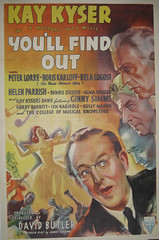
You'll Find Out (1940)
Lugosi, Karloff, and Lorre, 4 February 2005
IMDb lists this film as a Comedy / Horror / Musical / Mystery. While it does have elements of all four genres, none are portrayed very well. The comedy is weak. The horror is almost non-existent. While there are musical numbers, none is very memorable. And the mystery could be solved by a first grader. Sounds pretty bad, huh?
With all this having been said, I still enjoy this movie. Why? Boris Karloff, Bela Lugosi, and Peter Lorre make their only joint appearance in a film (that I'm aware of). Each provides a level of excitement and enjoyment to what would otherwise be a very forgettable movie. In the film, they are plotting together to scheme a rich heiress out of her fortune. It's up to Kay Kyser and his band to save the day. The plot involves psychics, poison darts, ghosts, trap doors, and hidden passageways. If you're a fan of Lugosi, Karloff, and Lorre, You'll Find Out can be fun.
5/10
With all this having been said, I still enjoy this movie. Why? Boris Karloff, Bela Lugosi, and Peter Lorre make their only joint appearance in a film (that I'm aware of). Each provides a level of excitement and enjoyment to what would otherwise be a very forgettable movie. In the film, they are plotting together to scheme a rich heiress out of her fortune. It's up to Kay Kyser and his band to save the day. The plot involves psychics, poison darts, ghosts, trap doors, and hidden passageways. If you're a fan of Lugosi, Karloff, and Lorre, You'll Find Out can be fun.
5/10
Subscribe to:
Posts (Atom)