Setting new standards in movie badness, 14 November 2007
I just finished watching Racket Girls and it's got me thinking about some of the ratings I've given other movies. Do those movies really deserve a 1/10 when compared with the hella bad Racket Girls? Is Hillbillys in a Haunted House as bad as Racket Girls? In comparison, Hillbillys was almost fun – stupid fun, but fun nonetheless. What about Zombie Lake? Zombie Lake comes close to falling into that "so bad, it's good" category – something Racket Girls could never hope to achieve. Sinbad of the Seven Seas? Lou Ferrigno can be good for an unintentional laugh or two – something I can't say about anything in Racket Girls. How about a movie like Red Zone Cuba? Well, you got me there – but Racket Girls is just as bad. I could go on and on, but you get the idea. Racket Girls has to be one of the very worst movies I've ever had the misfortune to see. Many of the other movies I've given low ratings to come out smelling like roses in comparison. The plot, such as it is, involves a shady wrestling promoter who is also into gambling, prostitution, and drugs. Nice fella, huh? He's got the local mob after him for $35,000 so he tries to have his girls throw a few matches to raise the cash he needs. They won't go for it so he tries to make a run for it. It's tacky, dull, and lacks anything in any way resembling entertainment. Movies truly don't get much worse than this.
There's really only one way to watch a movie like Racket Girls. The Mystery Science Theater 3000 commentary turns this piece of trash into a goldmine of laughs. It's a very solid effort on the part of the MST3K crew. I give it a 4/5 on my MST3K rating scale.
1/10
Showing posts with label 1951. Show all posts
Showing posts with label 1951. Show all posts
Saturday, August 28, 2010

Sunday, August 15, 2010
His Kind of Woman (1951)
"When I'm broke, I press my pants.", 26 April 2007
 In the world of the film noir, His Kind of Woman is something completely different from what I've become accustomed to. Some would argue that it's not even noir, but some sort of crime/adventure/comedy amalgamation. To me, it's definitely noir . . . with a twist. His Kind of Woman features three distinct acts. The first is the hard-boiled, loner with issues, dark noir you might expect. We meet Robert Mitchum, see him drink milk (that's right – milk) at a shady looking bar, and watch as he gets his brains beat in after returning home. End of Act 1. Things start to lighten up as soon as soon as Jane Russell enters the picture. Not really a comedy, the 2nd act instead reminds me of some sort of perverse Ten Little Indians where a diverse group of people seem to have been summoned together for reasons unknown. And it's quite the collection of characters – Mitchum as the tough as nails gambler, Russell the wannabe gold-digger, Vincent Price as the self-congratulatory actor, Jim Backus the gambler looking to take advantage of a young woman, and the assorted hoods, federal agents, and innocents. Act 3 is something different altogether. It features a bizarre contrast between Mitchum taking the beating of a lifetime and Price hamming it up complete with a cape and lines from Shakespeare. Watching Price take charge of a Mexican police force is absolutely hysterical. Even odder is the fact that the movie's leading lady spends most of this time locked in a closet. This unusual mix of film styles and genres may put off some, but the whole thing works for me.
7/10
7/10
Friday, August 13, 2010
Lost Continent (1951)
"Look at the size of that footprint!", 18 March 2007
 I don't quite understand the reviews for Lost Continent on IMDb. Most of the users who have taken the time to write a review have rated the movie a 5 or better. Huh? What did I miss? Sure, it's not the worst movie I've ever seen, but come on! Lost Continent is about as exciting as watching grass grow or watching paint dry or any other tired, old cliché you can think of. It's deathly dull! It seems that at least half of the movie is devoted to watching the characters either climb a mountain or just walk around. As a viewer, you get to watch all six characters going over the same boulder - and doing so very slowly - and without any tension or suspense - and often without any background music. And when our group of intrepid explorers isn't climbing over the same stage-bound rock for the fourth time, they're walking through a fake looking jungle. Actually, they're not really walking as it seems each time the camera cuts to them they're taking a fifteen minute break. How exciting is that! They don't do much and nothing much happens to them. Two-thirds of the movie is over before the first dinosaur makes an appearance. I realize that Lost Continent was made with a very small budget, but these dinosaurs are terrible. Movies made 20 years previous had better looking stop motion special effects.
But as I wrote earlier, Lost Continent is far from the worst movie I've seen. The acting alone keeps this thing from being a total waste of time. The name actors in Lost Continent are Cesar Romero and Hugh Beaumont. Both do a decent enough job, but they're not given much to stretch their acting abilities. Also present, as he was in seemingly everything made in the 50s and 60s, is Whit Bissell. The name might not be recognizable, but most fans of older films would be familiar with the face and voice.
3/10
I don't quite understand the reviews for Lost Continent on IMDb. Most of the users who have taken the time to write a review have rated the movie a 5 or better. Huh? What did I miss? Sure, it's not the worst movie I've ever seen, but come on! Lost Continent is about as exciting as watching grass grow or watching paint dry or any other tired, old cliché you can think of. It's deathly dull! It seems that at least half of the movie is devoted to watching the characters either climb a mountain or just walk around. As a viewer, you get to watch all six characters going over the same boulder - and doing so very slowly - and without any tension or suspense - and often without any background music. And when our group of intrepid explorers isn't climbing over the same stage-bound rock for the fourth time, they're walking through a fake looking jungle. Actually, they're not really walking as it seems each time the camera cuts to them they're taking a fifteen minute break. How exciting is that! They don't do much and nothing much happens to them. Two-thirds of the movie is over before the first dinosaur makes an appearance. I realize that Lost Continent was made with a very small budget, but these dinosaurs are terrible. Movies made 20 years previous had better looking stop motion special effects.But as I wrote earlier, Lost Continent is far from the worst movie I've seen. The acting alone keeps this thing from being a total waste of time. The name actors in Lost Continent are Cesar Romero and Hugh Beaumont. Both do a decent enough job, but they're not given much to stretch their acting abilities. Also present, as he was in seemingly everything made in the 50s and 60s, is Whit Bissell. The name might not be recognizable, but most fans of older films would be familiar with the face and voice.
3/10
Monday, August 2, 2010
Sirocco (1951)
Pale imitation of Casablanca, 24 April 2006
 I was going to begin with a detailed plot description of Sirocco, but what's the point? Sirocco has essentially the same plot as Casablanca. Change settings to Syria from Morocco, put Marta Toren in the role of Ingrid Bergman (Toren was actually billed as "The Next Ingrid Bergman"), exchange Lee J. Cobb's Col. Feroud for Conrad Veidt's Maj. Strasser, and throw in a few other similar characters and almost identical plot points and you've got two very similar movies. The problem with the comparison, though, comes at the end of the film. Although Casablanca is the far superior film in most every way, the final scenes really drive home just how inferior Sirocco really is. In both films, Bogart must decide between being selfish or doing "what's right". The difference, however, is that in Casablanca there is a good, justifiable reason for his actions. As heartbreaking as his final act is, I can understand why he made that decision. In Sirocco, on the other hand, the decision to do "what's right" seems totally out of character with everything leading up to that point. There is no valid, justifiable reason for Bogart's actions. There is no sound reasoning given for his sudden change of heart and it therefore feels forced to make Bogart look like a good guy before the end of the film. It just doesn't work.
The highlight of Sirocco for me is Marta Toren. She made even the most mundane of scenes seem elegant and worth watching. While she may have been "The Next Ingrid Bergman", personally I saw a lot of Audrey Hepburn in her. It's a shame that Toren's career was cut short by her untimely death in 1957. I, for one, would have liked to see what she would have done with a more complete filmography.
6/10
The highlight of Sirocco for me is Marta Toren. She made even the most mundane of scenes seem elegant and worth watching. While she may have been "The Next Ingrid Bergman", personally I saw a lot of Audrey Hepburn in her. It's a shame that Toren's career was cut short by her untimely death in 1957. I, for one, would have liked to see what she would have done with a more complete filmography.
6/10
Saturday, July 31, 2010
The House on Telegraph Hill (1951)
Robert Wise scores again, 16 March 2006
 The House on Telegraph Hill is a wonderfully entertaining thriller dealing with a woman living under an assumed identity and the child she claims as her own. The movie may be part of Fox's Film Noir Collection, but it's really more of a Hitchcock "woman-in-peril" type film. The movie may seem unusual when seen today with the modern emphasis on the plot twist. Throughout most of the film, I kept waiting for the inevitable twist that never materialized. The lack of a twist each time I thought I saw one coming was, in its own way, the best twist of all. The House on Telegraph Hill is deliberately paced and shot beautifully by Robert Wise. Some of the interior scenes, especially those in the hallway of the old house, look as good as you'll see. The acting is great with the relative unknown (at least unknown to me) Valentina Cortese giving a real standout performance. She has an undeniable screen presence and the ability to draw a viewer in. I really felt for her character's situation throughout the movie. The ending of the film is very nicely done and had me on the edge of my seat. As I was waiting for a twist, I was completely surprised by the final act. The drama and suspense are almost palatable throughout the film's finale. Overall, The House on Telegraph Hill is a very nice, under-seen film.
8/10
8/10
Thursday, July 22, 2010
The Thing from Another World (1951)
"An intellectual carrot. The mind boggles.", 4 August 2005

There are so many positive things to say about The Thing that narrowing them down to fit into a manageable size review is difficult. Very briefly, some of the things that impress me about The Thing include: the opening title sequence, the wonderful music score, the sets, the amazing kerosene fire scene, the terrific jump scare the first time we see the creature, and the desolate North Pole setting. Everything about the movie is near perfect as far as I'm concerned.
One of the most impressive things to me, however, is the decision to use the creature sparingly throughout the movie. Because we only catch glimpses of the alien, he remains a mystery and, as a result, more frightening. I don't know if this is the case or not as I've never heard John Carpenter speak on the subject, but as I watched the movie last night, I couldn't help be think of Carpenter's decision to use The Thing in his movie, Halloween. Surely it wasn't a coincidence (or a cheap plug for his upcoming remake). Instead, I've always felt that the way Carpenter used The Shape in Halloween is much like way the creature is used in this movie. I don't know if anyone agrees, but I definitely see similarities.
I can narrow down what makes this film so special to me into two words - Howard Hawks. If you're so inclined, there are any number of articles you can read on the internet about who really directed the movie - Hawks or Nyby. I don't know and I don't care, but it's easy to see Hawks' fingerprints all over The Thing. The most obvious example is the whole dialogue thing. In most of Hawks' movies I've seen, the dialogue is incredibly intelligent, snappy, and witty. It's part of what makes his movies so much fun. Hawks also had a way of getting actors to sound less like they were reciting lines and more like they were having actual conversations. Actors routinely step all over each others' lines and interrupt one another just like real people do. If you've ever seen His Girl Friday, you know exactly what I'm talking about. I love it.
I could literally go on and on discussing The Thing from Another World. I haven't even touched on the comparisons with The Day the Earth Stood Still (released the same year) or the treatment of the scientists vs. the treatment of the Army or the portrayal of women or the whole Soviet invasion subtext or the "Watch the skies" speech or ... you get the idea. It's truly a remarkable movie.
9/10
Tuesday, May 18, 2010
The Son of Dr. Jekyll (1951)
Where's Hyde?, 4 February 2005
 What a lovely movie to look at. Wonderful costumes and sets make this movie a real treat to the eye. Some of the best I've seen in a period horror film. The acting is also quite good. It's just too bad that this is all The Son of Dr. Jekyll has to offer.
It's easy to see why this film was titled The Son of Dr. Jekyll and not The Son of Mr. Hyde. Other than the opening scene where Hyde (I'm not entirely sure it was Hyde) has about five minutes of screen time, we see him for less than 10 seconds in the rest of the film. Very disappointing. Without Hyde, Dr. Jekyll has a tough time carrying a movie by himself.
The movie is really more of a crime mystery than a horror regardless of how it is listed on IMDb. The "son" spends the majority of the movie tying to figure out who is framing him as mad killer. While it is a decent enough idea for a movie, the killer's true identity is given away so early that there are few dramatic or tense moments later on.
4/10
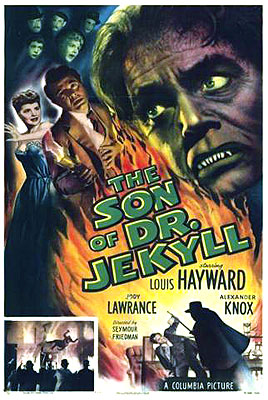 What a lovely movie to look at. Wonderful costumes and sets make this movie a real treat to the eye. Some of the best I've seen in a period horror film. The acting is also quite good. It's just too bad that this is all The Son of Dr. Jekyll has to offer.
It's easy to see why this film was titled The Son of Dr. Jekyll and not The Son of Mr. Hyde. Other than the opening scene where Hyde (I'm not entirely sure it was Hyde) has about five minutes of screen time, we see him for less than 10 seconds in the rest of the film. Very disappointing. Without Hyde, Dr. Jekyll has a tough time carrying a movie by himself.
The movie is really more of a crime mystery than a horror regardless of how it is listed on IMDb. The "son" spends the majority of the movie tying to figure out who is framing him as mad killer. While it is a decent enough idea for a movie, the killer's true identity is given away so early that there are few dramatic or tense moments later on.
4/10
Subscribe to:
Posts (Atom)